

7 Must-Have Fundamentals Every Link Building Strategy Needs
Listen to this article
Browser-native voice. No account required.
Problem Snapshot: Why Most Link Building is a Joke
Look.
You’ve been lied to.
You’ve been fed a watered-down, sugar-coated, AI-generated smoothie of “just write great content and the links will come.”
No. They won’t.
You’ve also been told guest posts are dead, directories are spam, and link exchanges will get you blacklisted faster than a hacker in a CIA database.
Also false. But the way most people do them? Desperate. Obvious. Ineffective.
Here’s what actually happens:
You post a “10 tips” article on your blog. No one links to it. You blame the algorithm.
You spam 87 blog owners with “Hi [First Name] I loved your article!” and get one pity link from a site that hasn’t ranked for anything since 2014.
You buy a Fiverr link package because some YouTube bro said it’s what he did to scale to $100k/month.
And you still wonder why your domain rating hasn’t moved in 6 months.
That's why in this article we will talk about "7 Must-Have Fundamentals Every Link Building Strategy Needs."
This is the turning point. Either you keep doing what’s safe and invisible, or you burn the old script and write one that works.
Killer Takeaways (no Fluff, No Excuses):
If you’re not building links, you’re not building SEO. Authority doesn’t come from vibes, it comes from other sites vouching for you.
“More links” means nothing if they’re trash. One solid backlink from a trusted, niche-relevant site beats 100 spammy blog comments every time.
Tactics get you traffic. Strategy builds empires. Stack guest posts, digital PR, viral content, and outreach into a cohesive plan or watch your efforts scatter like confetti.

Creating viral content that resonates with the audience can naturally generate a high volume of white-hat backlinks, significantly impacting a website's SEO performance.
The Mechanism: Authority Layers and Semantic Gravity
Google doesn’t care how hard you worked. It cares how well your content sits in its map of the web.
That map is built on:
Entities: Who you are, what you offer, what you’re connected to
Trust signals: Who links to you, in what context, with what anchor, from what domain
Semantic relevance: Whether your link profile aligns with your topic cluster
This is why one link from a niche-relevant high-authority site with great anchor context is worth more than 200 random-ass blog comments and “submit your startup” directories.
This is what we build toward.
Let’s break down the 7 battle-tested, algorithm-proof fundamentals of a link building strategy that actually wins.

1. Competitor Backlink Intelligence (a.k.a. Steal Their Links and Steal Their Lunch)
You don’t need to “guess” where to get links.
You don’t need another generic list of “top 100 places to submit your blog.”
You need a roadmap. And guess what?
Your competitors already built it.
If they’re ranking, they’re getting links. If they’re getting links, those links are findable. And if they’re findable, they’re stealable.
No, not in a shady, blacklist-your-site kind of way. In a smart, ruthless, “I’m better than them and I’ll prove it” kind of way.
Here’s the game plan:
Step 1: Pull the curtain on their backlink profile
Fire up Ahrefs, Semrush, or Majestic. Plug in their domain.
What you’re looking for:
Referring domains (not just number, but quality and niche relevance)
Top-linked pages (which content gets the most love)
Link types: guest posts, interviews, citations, editorial links, forums, directories
Anchor text breakdown (this is where most SEOs get exposed)
Most people stop here and say, “Cool, they’ve got 412 referring domains.”
You? You go deeper.
Step 2: Find the link magnets
Which pages pull in the most backlinks?
Usually it’s:
Ultimate guides (long-form, detailed, evergreen)
Data reports (original research, industry stats)
Controversial opinion pieces (if they took a stand, they earned attention)
Free tools or calculators
Infographics that don’t suck
This tells you exactly what kind of content earns links in your niche.
If your competitors are getting links to a “2024 Marketing Trends” post, guess what? You don’t copy it. You 1-up it.
Find what they’re missing. Add stats they skipped. Cover angles they ignored. Outsource a custom visual. Interview someone they couldn’t get.
Then reach out to the same people who linked to theirs and offer yours, using a manual link building workflow instead of spray-and-pray.
It’s not copying. It’s chess. With blood.
Step 3: Spot the “easy win” domains
Here’s a secret:
Not all backlinks are hard to earn. Some domains link out like it’s Halloween and they’ve got too much candy.
These are often:
Industry roundup blogs
Resource pages
Curated content newsletters
Niche forums
Startup directories
Contributor-based sites (they’re hungry for content)
If you find these in your competitors’ profile, you don’t need to guess.
You contact them. You pitch something better. Or more updated. Or more useful.
They’ve linked to similar stuff before they’ll do it again.
Step 4: Find what they don’t have
This is where most SEOs stop short.
You don’t just match their links. You leapfrog.
Use link gap tools in Ahrefs or Semrush to compare you vs multiple competitors.
What domains link to 2 or 3 of them but not you?
Those are hot prospects. That’s a pattern. And Google loves patterns.
Even better?
Find verticals they’re not touching.
Maybe they never get links from academic journals. Or nonprofit partners. Or podcasts. Or local news outlets.
You go get those. You build a profile they can’t clone.

2. Content That Demands Links (because "good Enough" Is for Losers)
Let me guess.
You wrote a blog post. It’s titled something like “Top 10 Tips for Marketing in 2024.” It has subheadings. A stock photo of a guy smiling while pointing at a whiteboard. You hit publish.
Then you waited. Maybe you even prayed. Nothing happened.
Why?
Because no one links to content that exists. People link to content that dominates.
You want backlinks? You have to make something that triggers a psychological need to link. Package it inside a focused content marketing plan so it actually ships.
Make them say:
“If I don’t reference this piece, my content will look incomplete.”
That’s the bar. Anything less is wasted effort.
Here’s how you get there.
First, your content needs a spine.
This isn’t fluff. This is architecture. You build it like a fortress:
Original Data – Run a survey. Analyze industry stats. Even scrape Reddit and package the insights. Data builds trust and earns links.
Contrarian Take – Say what no one else is saying. Attack the sacred cows. Have a spine and people will respond.
Depth, not length – You don’t need 5,000 words of filler. You need 1,500 words that slap. Show depth, nuance, and real answers.
Clear takeaways – Don’t just explain. Teach. Solve. Offer frameworks. People link to value, not waffle.
Second, wrap it in something sexy.
“Ultimate Guide” doesn’t cut it anymore. Your titles, structure, and visuals need to punch.
Use fascinations. Steal from magazines, direct response. Example: Boring: “How to Do a Link Audit” Better: “The 9 Backlink Red Flags That Will Get You Nuked by Google”
Use visual anchors: Custom graphs Flowcharts Infographics (with embed codes!) Click-to-copy templates
Turn static into tools: Embed calculators Add downloadable checklists Create swipe files
Third, make it a linkable asset, not just an article.
Content that earns links isn’t blog content. It’s a resource. A destination. Something others feel obligated to cite.
Examples:
Glossaries – Especially in tech, finance, SaaS. Glossaries get evergreen backlinks.
Stat pages – “Marketing Stats 2025” or “Remote Work Statistics.” Everyone needs a number to drop in their post. Be the one who collects them.
Templates – Outreach templates, audit checklists, SOPs. These get linked in blog posts, newsletters, even courses.
Want proof?
Sites like HubSpot, Moz, and Backlinko built their link empires off of templates, data, and ultra-specific how-tos. Not opinions. Not “trending tips.”
They built weapons. Then they watched the internet use them.
What NOT to do:
Write for keywords only without a human or intent in mind
Write vague posts with no angle
Use generic headers like “Introduction” and “Conclusion”
Publish without adding visuals, examples, or utility
Use filler to chase word count instead of delivering value

3. Guest Posting That Doesn’t Suck (or Get Ignored)
You’ve heard it before: “Guest posting is dead.”
Bullsh*t.
It’s only dead if you’re doing it the way most marketers do it like a desperate intern begging for a favor from someone they’ve never met.
You know the drill:
“Hi there! I stumbled upon your blog and thought I could provide value with a guest post. Let me know!”
That email gets deleted faster than a LinkedIn pitch from a crypto bro.
Guest posting still works. But only if you bring value, clarity, and a pulse. And if you want to understand how it stacks up against other tactics like niche edits, check out our breakdown of guest posts vs niche edits.
Here’s how to do it like someone who knows what they’re doing.
Step 1: Target sites that actually move the needle
Not every backlink is worth chasing. You’re not building a scrapbook here you’re building authority.
Focus on:
High-DR sites (50+ ideally, unless niche is small)
Actual organic traffic (check with Ahrefs or SimilarWeb)
Niche relevance - if you’re SaaS, pitch SaaS blogs. If you’re in ecom, don’t pitch tech-forums-for-dads-dot-net
Use filters in Ahrefs: "backlinks to competitors" → "DR 50+" → "Blog posts" → "Dofollow" → sorted by traffic.
Boom. Target list of dofollow backlinks.
Step 2: Pitch something they can’t ignore
Here’s where most people fail. Their ideas are generic, uninspired, and obvious.
You want your pitch to punch through the noise like a brick through drywall.
Try this instead:
Reference their recent posts by title, not just “your blog”
Suggest a topic that fills a real gap in their content
Include 2-3 headline options all built to rank, not bore
Example:
“Noticed you don’t have anything covering ‘link velocity’ or how anchor text diversity impacts NLP relevance. Got a spicy idea for a post:
“How Over-Optimized Anchor Text Can Kill Your Rankings And What to Do Instead”
Would fit right into your ‘Advanced SEO’ category. I’ll make it tight, punchy, and full of examples from Ahrefs data. Sound useful?”
You’re not just offering content. You’re offering power. You’re making them look smart to their readers.
Step 3: Write like it’s your blog, not theirs
The biggest mistake? People dumb down their guest posts.
That’s a waste.
This is your stage. Show off. Teach. Sell your brain.
Include outbound links to trusted sources (Google, Moz, Harvard Biz Review)
Reference your own blog only where it actually adds value
Use your tone. Use your voice. The kind that makes the reader remember your name.
If your guest post feels like a ghost wrote it in a coma, you’ve already lost.
Step 4: Treat one link like the start of a relationship
Guest posting is long game. Every successful post should lead to:
Future invites
Newsletter mentions
Collaborative content
Podcast guest spots
Follow up. Share their content. Tag them. Stay in orbit.
Most SEOs treat it like a one-night stand. You treat it like a business partnership. That’s the difference.

4. Local SEO & Directory Listings (the Link Building Power Move Everyone’s Ignoring)
Let’s talk about something tragically underrated in the link building game.
Local directories.
I know. Not sexy. Not scalable. Not part of your next “7-figure funnel.”
But if you ignore them, you’re literally handing visibility, traffic, and trust to your dumber, slower, local competitor just because they bothered to list themselves correctly on Yelp.
Here’s the truth: local citations aren’t just for pizza shops and plumbers. They’re for any business that wants Google to understand where, what, and who the hell you are.
Because Google’s local algorithm is a hungry, structured-data-devouring machine. And these listings are its buffet.
Case Study: How this finance website increased organic traffic by 460% with link building.
Step 1: Claim your territory with hardcoded NAP
NAP = Name, Address, Phone.
But it’s more than that. It’s the foundational identity of your business across the web. If your business shows up with different phone numbers or old addresses on multiple platforms, guess what?
Google sees inconsistency. And inconsistency kills trust.
You must have:
Identical NAP across Google Business Profile, Bing Places, Yelp, Apple Maps, BBB, Trustpilot, Foursquare, Chamber of Commerce, etc.
A homepage schema with LocalBusiness or Organization markup that matches your listings
Reviews, hours, photos - the works
This isn’t “just for locals.” This is for trust. Google eats this up and uses it to cross-verify your legitimacy.
Step 2: Build relevance through local keywords
Even national brands can benefit from local link signals. Why?
Because Google’s algorithm still ties authority to geography.
If you're a SaaS company in Austin, link signals from Austin-based publications, events, local biz blogs, or startup hubs give you a trust layer your generic link-building campaign never could.
Build citations and links from:
Local business directories (industry + city)
Local university or college pages (sponsor events, offer student discounts)
Local news media (send press releases, offer expert quotes)
Local events (host, attend, or partner - then get on their websites)
Don’t say “we’re not local.” You exist somewhere. Make that somewhere work for you.
Step 3: Weaponize reviews and user-generated content
Google doesn’t just scan your citations. It reads your reviews.
Yes, its NLP models extract:
Sentiment
Relevance (keywords mentioned)
Contextual signals (“fast delivery,” “excellent service,” “locally sourced,” etc.)
So when customers write reviews that mention your service + location + benefit?
That becomes semantic gold for your rankings.
Want more reviews? Email your top clients. Bribe them (legally). Automate reminders. Print a QR code on your receipts. Just get them.
Step 4: Bonus: build backlinks from your local ecosystem
Sponsor a local podcast? Get a backlink.
Speak at a chamber event? Get a backlink.
Donate to a nonprofit? Get a backlink.
Host a Meetup? Backlink.
These are easy, relevant, underused links that make you look like a leader in your area and Google sees that.
If you’re building trust and relevance signals locally, you’re not just stacking links. You’re stacking credibility.
If you’re too proud to list your SaaS business on Yelp, while your competitor’s cleaning up with 480+ five-star reviews and a Google Maps link in the local pack, that's not a strategy. That’s ego.
Google doesn’t care how sophisticated your funnel is. It cares how many trust signals point to your business. Period.

Pro Tip: Offer unique insights or proprietary data that other contributors aren’t providing. Editors love fresh takes, and search engines reward the added value.
5. Digital Pr: the Link Building Power Move with Media-Grade Authority
If SEO is the war for attention, Digital PR is the airstrike.
This isn’t about sending some dusty press release to a list of overworked journalists who haven’t opened a pitch since 2012.
This is about earning backlinks from media sites, national publishers, niche blogs, and high-authority outlets by crafting a story that demands coverage. Pair it with a targeted press release when timing matters.
This is where most link building campaigns flatline. Because they’re trying to earn trust while sounding like an AI wrote their email.
So let’s rewrite the rules.
Step 1: Find your angle, not your announcement
No one cares that you launched a new feature. No one wants to cover your internal milestones. No journalist wakes up thinking, “I wonder what new plugin that SaaS tool released today.”
They care about:
Conflict
Data
Culture
Trends
Underdogs
Firsts
Outrage
Contradictions
Your job is to find the story behind your business. Something that connects to larger trends. Something a journalist can plug into a real narrative.
Ask:
What problem do we solve that no one’s talking about?
What have we discovered through our user data?
How can we challenge the current norm?
Example:
You’re a mental health startup. You analyze anonymized usage data and realize that anxiety spikes on Mondays after 10 a.m. You package it as:
“Why Mondays Are Emotionally Dangerous - New Study Shows the Hour You’re Most Likely to Burn Out”
That gets picked up. Covered. Cited. Linked.
Digital PR done right turns your business into a source.
Step 2: Create pitch material worth opening
Journalists get 300+ pitches a day. Your subject line must punch. Your body must deliver. Your CTA must be irresistible.
Subject line tips:
Use data: “New Study: 74% of Marketers Still Don’t Track This Metric”
Use fear: “Google Just Quietly Changed This SEO Rule - We Analyzed the Impact”
Use conflict: “This Startup Is Betting Against Influencer Marketing - And It’s Working”
Body copy tips:
First sentence = hook
Second = who you are and why this matters now
Third = the asset (study, story, expert quote)
Close with a link to your data or landing page
Offer exclusivity if you can
Step 3: Create content worth linking to
You don’t just want coverage. You want links.
So you need an on-site asset that they can reference and link to.
This could be:
A custom data report
A long-form blog post with original stats
A press landing page with visuals, charts, video
A quote bank from subject matter experts
A PDF download (yes, even PDFs get backlinks)
Don’t just give them the story give them a place to send their readers.
That’s the link.
Step 4: Build journalist relationships (the real ROI)
You don’t need 1,000 contacts. You need 5 good ones.
Use Muck Rack, HARO, or Prowly to find relevant writers
Follow them on X (Twitter)
Engage before you pitch
Share their work
Offer fast, expert quotes when they’re on deadline
Be their source. Not their stalker.
If a journalist knows you as the person who responds fast with great insights - you’ll get links all year. You’ll show up in roundups, interviews, even syndicated stories.
This is how the pros do it.
If your “PR strategy” is just you cold-emailing random editors and hoping someone cares - that’s not outreach. That’s digital panhandling.
Tell a real story. Make it big. Then weaponize it.

6. Viral Content: Emotional Triggers That Print Links on Autopilot
Let’s kill a myth right now.
Going viral is not luck.
It’s not random.
And it’s definitely not about “hacking the algorithm.”
It’s about human psychology. Deep, messy, emotional psychology.
The content that spreads, and racks up backlinks without you lifting another damn finger, does one thing exceptionally well:
It makes people feel something strong enough to share it.
Most marketers write content that makes people think.
That’s why it sits there collecting dust.
If you want backlinks to roll in without you begging, your content has to move people.
Step 1: Use emotion like a weapon
The three emotions that trigger the most shares and links?
Awe: “Holy sh*t, this changes everything.”
Anger: “This is outrageous, people need to know.”
Amusement: “This is hilarious, I’m sending it to everyone.”
Everything viral rides on one of these.
The Blendtec “Will It Blend?” series?
Amusement.
Millions of views. Thousands of links. Countless copycats.
Spotify Wrapped?
Awe.
People show off their stats. Press picks it up. Blogs link it. Viral every year.
The New York Times “How Y’all, Youse, and You Guys Talk” quiz?
Fascination + ego.
Most-linked piece on their site for years.
What’s your angle?
You don’t need to be funny. Or loud. Or controversial.
But you do need a hook that hits like a left hook from Tyson.
Try these:
“We Analyzed 1 Million Job Listings: Here’s the One Word That Predicts a Bad Manager”
“You’re Not Burned Out. You’re Bored: And That’s Worse”
“97% of Productivity Hacks Are Bullsh*t: These 3 Actually Work”
Step 2: Make it stupidly easy to share
The content itself can’t be a wall of text. No one shares a thesis.
It needs to be:
Visual: Use custom charts, memes, mini-infographics, pull quotes
Interactive: Quizzes, calculators, tools
Scannable: Short sentences, bold headers, highlight boxes
Portable: Embed code, social snippets, tweetable quotes
Remember: people don’t link to things that look hard to share.
They link to the thing that’s fast, flashy, and makes them look smart.
Step 3: Engineer a viral loop
This is where it gets strategic.
What happens after they click?
Do they:
Get a CTA to share?
See their name on a leaderboard?
Get a stat they want to flaunt?
Unlock bonus content?
This is the difference between 1,000 visitors and 100,000.
Every viral piece needs a share trap - something that makes the reader think, “Other people need to see this.”
Examples:
“Share your results” widgets
“Tweet this stat” buttons
Gated bonus content after a social share
Embedded code for infographics with your backlink built in
Step 4: Watch the backlinks stack themselves
Here’s where the SEO magic kicks in.
As your viral piece spreads, people start referencing it:
Blog posts
Newsletters
Podcasts
Reddit threads
Roundups
Academic articles
You don’t have to do outreach.
The content does it for you.
You just need to make sure your original source page is linkable:
Short URL
Authoritative design
Fast-loading
Embed-friendly
Clear attribution instructions
If your content doesn’t make someone laugh, cry, or scream into the void - it’s not going viral.
It’s going nowhere.
Write for humans first. Links will follow like sharks to blood.
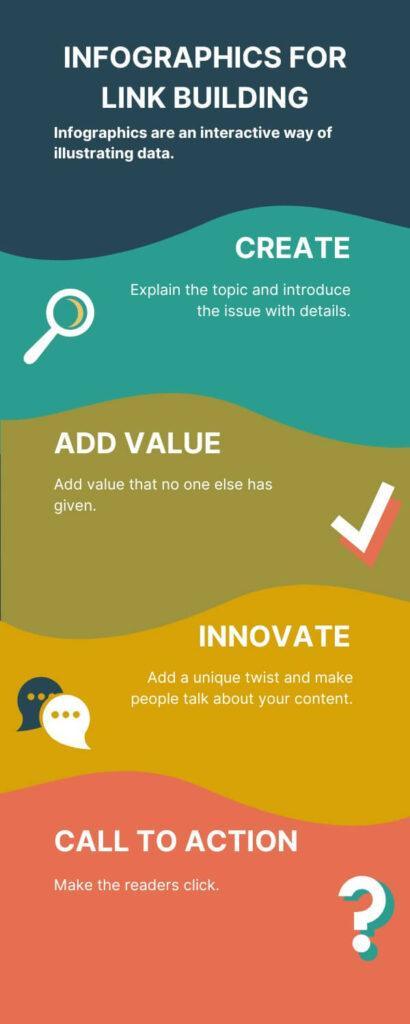
7. Infographics: the Silent Assassin of Link Building
Infographics.
You’ve seen them.
Some are stunning. Some are trash. Most are forgettable.
But the good ones?
They work. Quietly. Relentlessly. Like a sniper with a PhD in information design.
Infographics are still one of the most underused, misunderstood, and unfairly mocked link building assets on the web - because 90% of marketers don’t know how to use them.
Let’s fix that.
Step 1: Understand why they still earn links
Google loves structured data.
Humans love scannable data.
Infographics are where these two needs shake hands and say, “Let’s go viral.”
When done right, an infographic:
Simplifies a complex idea into one visual
Makes data instantly shareable
Gets picked up in roundups, blog posts, slideshows, lectures, and forums
Earns you embedded backlinks from everyone who uses it
But here’s the catch: 95% of infographics are designed like a PowerPoint slide by a bored intern.
If it looks cheap, crowded, or template-driven, nobody’s embedding that garbage.
Step 2: Pick topics that demand visuals
Don’t make an infographic about “7 Social Media Tips.” That’s a blog post pretending to wear a costume.
Make infographics about things people need help visualizing:
Processes or frameworks (“The 5-Step Customer Retention Funnel”)
Industry data (“2025 Email Open Rates by Industry”)
Contrasts or comparisons (“Freelancer vs. Agency: Costs, Speed, Quality”)
Hierarchies (“Types of Marketing Attribution Models Ranked by Accuracy”)
Timelines (“How Google’s Algorithm Evolved From 1998 to 2025”)
Think: what would make someone pause and screenshot this?
That’s your topic.
Step 3: Design it for virality not vanity
Don’t design for yourself. Design for the blogger who wants to steal it.
Here’s how:
Readable at a glance: No 8pt fonts. No clutter. No walls of text.
Vertical layout: They embed better, especially on mobile.
Clear source attribution: Your URL and brand included but not obnoxious
Embed code below it: With a copy-paste snippet that includes a link back to your original page
Optional download version: Great for getting shared in Slack channels, Notion docs, Google Slides
Pro tip: Add a call-to-action above the graphic.
“Want to feature this infographic? Grab the embed code below.”
You’d be shocked how many people will link you just because you made it easy.
Step 4: Syndicate like a savage
Once published, don’t sit back. You’re not done.
You:
Email niche bloggers who’ve covered similar topics
Submit to infographic directories (there are still a few that matter)
Share in communities where your audience hangs (Slack groups, Discords, LinkedIn pods)
Repurpose it into a LinkedIn carousel, Pinterest pin, or YouTube Short with voiceover
Every use case becomes another potential link opportunity.
Infographics are content multipliers. That’s why they quietly outperform most blog posts for links.
Bonus: Stack with Guest Posts or PR
Have a killer infographic?
Use it as a pitch asset in guest post outreach
Reference it in your digital PR press kits
Offer it as a free insert in someone else’s guide (they embed, you win)
It’s visual content that sells without needing words (which is why journalists and bloggers love it).
Infographics don’t beg for backlinks.
They stand there, looking beautiful, and let everyone else do the work.
If your blog posts are getting ghosted, give ‘em something hot to look at.
In short, always ask, Does this link add authority and relevance to my niche? If not, it’s not worth your time.
How to Actually Balance Tactics and Strategy Without Screwing Yourself
Let’s make this crystal clear.
Tactics are sprints. Strategy is the damn marathon.
And most SEOs?
They either:
Obsess over tactics with zero long-term vision (shiny object chasers),
Or sit around “strategizing” while their competitors gobble up every link opportunity like it’s Black Friday at an affiliate convention.
Neither wins.
The secret to building a backlink profile that Google trusts and rewards is knowing when to hit fast and when to build deep.
Here’s how you do both without setting your domain on fire.
Tactics: the Quick Wins That Stack Momentum
Tactical link building is about speed, precision, and short-term ranking power.
Use it to:
Boost new pages or content assets
Capitalize on timely trends
Fill link gaps vs competitors
Diversify your anchor text
Keep your link velocity healthy
Tactical Moves That Actually Work:
Broken link building
Guest posting on niche blogs
Directory citations for local or structured data
Link reclamation (fixing mentions with no link)
HARO responses for quick press hits
Skyscraper outreach (but only if your content actually slaps)
These are repeatable. Measurable. Fast.
But they’re just firewood.
You need strategy to start the fire.
Strategy: the Long Game That Builds Authority
Strategic link building is about brand, reputation, and long-term domain trust.
It answers one question:
“What link profile will Google expect from the #1 site in this niche?”
Then it builds toward that.
Strategic Moves That Actually Build Moats:
Creating linkable assets (data reports, tools, ultimate guides)
Building relationships with publishers, editors, podcast hosts
Consistently earning links through PR, not just begging for them
Dominating a topical cluster until Google sees you as the source
Developing proprietary frameworks or concepts people cite
Turning your founder/expert team into quote machines for journalists
Strategic links come slower.
But they compound.
They turn your brand into a destination.
And when that happens, you don't build links you attract them.
How to Balance Both Without Wasting Tim
Map your asset types.
Is this a link magnet (data post, infographic, tool)? → Strategic
Is this a link driver (guest post, HARO pitch)? → Tactical
Use both. Assign goals to each.
Build sprints into your campaigns.
Each quarter, run a tactical blitz (e.g., 20 guest posts, 15 resource page outreach, 3 HARO wins).
Track DR, anchor text, and ref domain growth.
Layer in strategic assets monthly.
While sprints run, work behind the scenes on:
Data research
Building a quote bank for PR
Relationships with high-level publishers
Cross-promotion with influencers
You’ll have new assets ready when your tactical campaigns need fuel.
Don’t spread thin, go deep in waves.
You don’t need every tactic, every month.
Pick 2–3, go deep, measure, then rotate.
The Golden Rule: Strategy Sets the Map. Tactics Move the Needle.
You don’t choose one.
You stack them.
You use tactics to climb.
You use strategy to stay at the top when everyone else is sliding back down.
Getting Started with Link Building
Your first step? Audit your current link profile. Use tools like Ahrefs or Semrush to identify gaps and opportunities. Is your anchor text too repetitive? Are your backlinks too niche or too broad?
Next, spy on the competition. Where are their backlinks coming from? Competitor analysis offers a roadmap of what works and how to do it better.
Then, focus on content creation. Build resources so good they become a must-link:
• A definitive guide
• An interactive calculator
• Research-backed reports
Combine this with genuine outreach, and you’ll build a link profile that grows your authority and rankings over time.
You can’t improve what you don’t measure. By tracking metrics like new backlinks, referral traffic, and domain authority, you can identify what’s working and refine your strategy. Tools like Ahrefs or Google Analytics make it easy to stay on top of your progress.
FAQ (because You’re Still Overthinking This)
What’s the fastest way to get backlinks that actually matter?
Steal your competitors’ best ones.
Use Ahrefs or Semrush, analyze their top-linked content, and create something better. Then pitch it to the same sites. Simple. Brutal. Effective.
Is guest posting still worth it in 2025?
Only if you stop writing like a LinkedIn bot.
Guest posting works if the site has authority, your post delivers real value, and your links actually fit the topic. If you're still sending “Dear Webmaster” emails - yeah, it’s dead for you.
What makes a link “high quality”?
Three things:
Relevance: Same niche, aligned topics
Authority: DR 50+ or trusted in the space
Context: Surrounded by legit, non-spammy content with natural anchor text
Google doesn’t just read the link. It reads the neighborhood.
Should I buy backlinks?
You can.
But know this - most of what’s sold is garbage wrapped in glitter.
If it’s a link from a PBN, spun guest post, or some $29 “exclusive” offer? You’re buying risk, not rankings.
How many backlinks do I need to rank?
Wrong question.
You need the right backlinks from diverse, trusted, and topically-aligned sources. Ten of those beat a hundred irrelevant ones. Always.
What’s the difference between link building and digital PR?
Link building asks for links.
Digital PR earns them by creating newsworthy, data-rich, or emotionally charged content that journalists want to cover.
Think press, not pestering.
How often should I audit my backlink profile?
Every 90 days minimum.
Check for spammy domains, toxic links, and anchor text cannibalization. Use Ahrefs or SEMrush’s audit tools. Disavow junk. Keep your link ecosystem clean.
What’s the one thing to avoid in a link building campaign?
Desperation.
If your outreach sounds like you’re begging, you’re dead in the inbox.
Lead with value, data, relevance, or don’t send the email.
Bart Magera
Founder of Mojo Links. 10+ years in SEO across YMYL verticals.
Related posts
Keep reading on adjacent topics.

The Perfect Backlink Audit Guide - Do It the Right Way
Think your backlinks are helping you? Prove it. Most websites are sitting on a pile of link rot. Old junk. Toxic links. Stuff search engines side-eye while tanking your search rankings behind the scenes. This backlink audit guide is not a theory lesson. It’s your hands-on…

Link Building Statistics 2025: 50 Data Points SEOs Can’t Ignore (unless They Want to Stay Broke)
Forget what some AI bro told you in a Discord.Backlinks still matter. They always did. Despite Google’s PR spin about "great content" and "helpful updates," every serious SEO knows the game runs on links. Real links. From real sites. With real authority. The difference now? It’s…
How to Check Backlinks Manually (yes, Without a Damn Tool)
Wondering how to check backlinks manually? Good. Because while everyone's busy worshipping overpriced SEO tools, you're about to learn how to do it the real way - eyes on source code, fingers on keyboard, no AI fluff or fake numbers. If there's a backlink out there pointing to…
Want this kind of analysis on your site?
Get a free video walkthrough within 48 hours covering technical health, backlinks, content gaps, and AI visibility.